To help prevent food allergies and intolerances in your restaurant, this article explores how to properly manage allergens in the kitchen — a fundamental aspect of maintaining food safety and HACCP compliance in your business.
Why Allergen Management Starts in the Kitchen, Not on the Menu
Allergen management begins in the kitchen, not on the menu. While it is mandatory to provide an allergen menu in the hospitality industry, true prevention and safety start with the reception and storage of food products.
The kitchen is the critical point where cross-contamination can occur if there are no clear protocols for handling, storing, and cleaning food products.
Therefore, in addition to organizing cold storage room units and workspaces, it is essential to monitor the utensils used and kitchen processes. All of this helps reduce health risks while conveying professionalism and trust in your business.
At Araven, we are here to support you. We are experts in developing innovative hospitality products designed not only to guarantee operational excellence, but also to help businesses comply with current regulations. Discover our catalogue today!
professional kitchen
Discover Araven products to preserve, transport and organise better in professional kitchens.
Quick Legal Overview: Regulation (EU) 1169/2011
Did you know that allergen management in restaurants is regulated in Europe under Regulation (EU) No. 1169/2011? This official regulation establishes the obligation to inform consumers about the presence of the 14 mandatory declarable allergens in food and beverages.
“Information about potential allergens is considered highly important. There is evidence that most food allergy incidents originate from non-prepacked foods. Therefore, information on potential allergens should always be provided to consumers.”
In addition, the law not only requires businesses to inform customers correctly, but also to implement internal systems that enable ingredient control and product traceability in order to reduce the risk of cross-contamination during food preparation.
The 14 Mandatory Declarable Allergens: An Operational Reminder
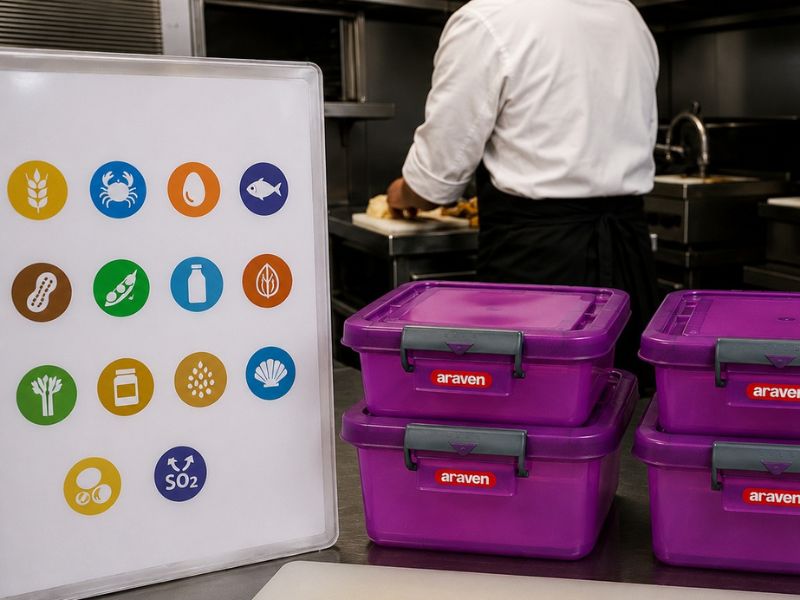
If you are wondering how to create an allergen menu — and properly manage allergens in the kitchen — it is important to first remember the 14 mandatory declarable allergens:
- Cereals containing gluten: wheat (such as spelt and khorasan wheat), rye, barley, oats, and their hybridised strains and derived products
- Crustaceans and products containing crustaceans
- Molluscs and products containing molluscs
- Fish and fish-based products
- Eggs and egg-based products
- Peanuts and peanut-based products
- Soybeans and soy-based products
- Milk and dairy products (including lactose)
- Tree nuts and derived products: almonds, hazelnuts, walnuts, etc.
- Celery and celery-based products
- Mustard and mustard-based products
- Sesame seeds and sesame-based products
- Sulphur dioxide and sulphites at concentrations above 10 mg/l or 10 mg/kg
- Lupin and lupin-based products
Receiving and Storing Food: Preventing Problems Before Cooking
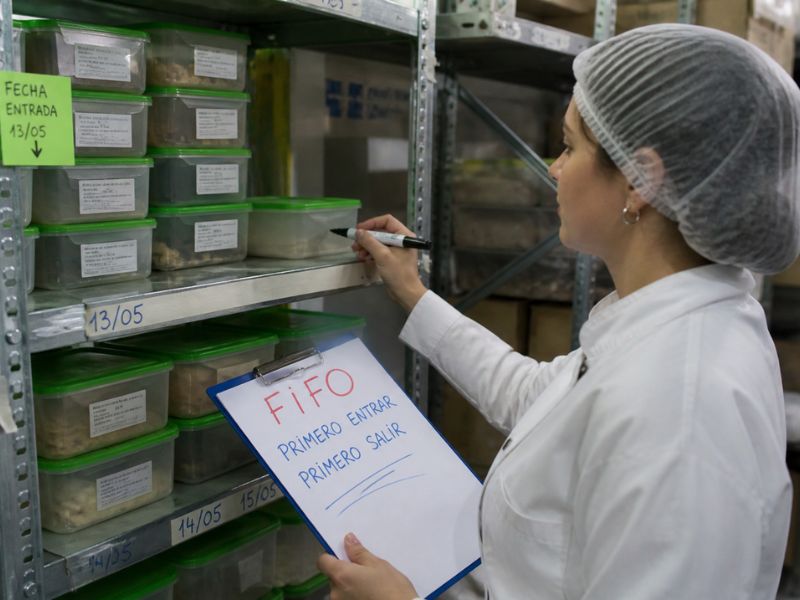
The first step in allergen management in the kitchen is ensuring the correct reception and storage of food products. To achieve this, it is essential to check the traceability label and technical specifications of every product received. These provide valuable information for maintaining strict supplier control.
An apparently standard ingredient may introduce new allergens if the supplier changes its composition. This is why staying alert and checking labels regularly is so important.
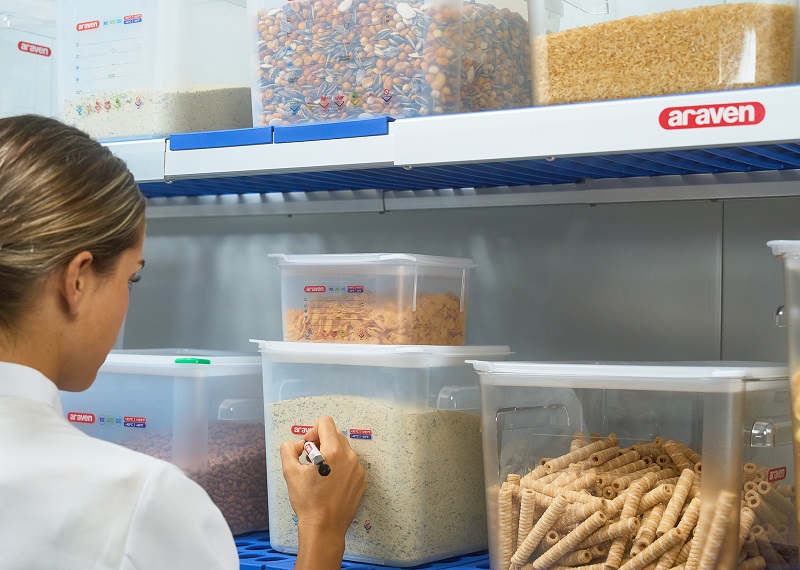
During storage, products containing allergens must be clearly identified and kept separate from other raw materials. Using sealed, colour-coded containers, designated storage areas, and visible labelling helps prevent accidental contamination. It is also advisable to organize cold rooms and storage areas logically, avoiding situations where powdered or liquid ingredients could spill onto other foods.
At Araven, we offer a range of anti-allergen Gastronorm airtight containers. These purple anti-allergen containers are specifically designed to guarantee safe food preservation and protect foods from the risk of allergen cross-contamination.
Safe Food Handling in the Kitchen: Physical and Time Separation
Allergen management in the kitchen continues throughout the food preparation process. During preparation, cross-contamination can occur through direct contact, shared utensils, or poorly cleaned and sanitised surfaces.
To prevent this, in addition to physically separating preparation areas or using dedicated utensils for specific dishes, it is highly recommended to use differentiated equipment. A good example is colour-coded cutting boards.
If separate preparation areas are not available in the kitchen, the order of preparation becomes crucial. In this case, it is recommended to prepare “free-from” dishes first (for example, gluten-free or lactose-free dishes) before handling ingredients containing allergens.
Storing Prepared Foods with Allergens: Airtight Containers, Labelling, and Traceability
Another key rule in allergen management is that prepared foods — from stews to sauces — must be stored in airtight containers that are correctly identified. Labels should include the product name, preparation date, and allergen information to facilitate both internal control and product traceability.
Cleaning Between Preparations and Hygiene Plans
Cleaning and disinfection are among the most important aspects of allergen prevention in the kitchen. It is not enough to simply remove visible food residues; complete sanitisation is required to eliminate even microscopic traces.
Surfaces, utensils, work clothing — everything must be cleaned and disinfected according to food safety protocols. Remember: cross-contamination can be both direct and indirect.
Team Training and Communication with Front-of-House Staff
The entire team, both kitchen and front-of-house staff, must receive allergen training, such as food handler certification. Kitchen staff must know how to prepare dishes according to allergen protocols, but communication with front-of-house staff is equally essential.
After all, waiters and waitresses are the professionals responsible for communicating this information to customers.
Allergen Management Plan: What Should Be Documented
Finally, it is important to highlight the need for a documented allergen management plan in the kitchen. All procedures related to the identification, handling, and control of allergenic ingredients should be clearly recorded.
Having this documentation not only helps ensure legal compliance, but also improves internal organisation and strengthens food safety within the establishment.
At a minimum, the following should be documented:
- An updated list of allergens present in products and recipes
- Supplier technical data sheets
- Reception and storage protocols
- Measures to prevent cross-contamination
- Cleaning and disinfection procedures
- Labelling and traceability systems
- Staff training records
- Internal communication and customer service protocols
Did you find this article useful? At Araven, we not only provide the best products on the market, but also the most valuable information to help your business succeed.